
Brain Emissions.
My Brain is emitting serious academic signals.
My Brain is emitting serious academic signals.
Recently I have been toying with the idea of a PhD. Not for teaching purposes though. The teacher's reward as the cliche goes is in heaven. Do I want to necessarily wait that long for my reward? My mum is a teacher and she's done all the teaching we need in the family. I don't think I necessarily want to teach. Don't get me wrong. I think teaching is an excellent career if you have the knack for it. In my profession teaching may mean liberty to stay in the center of your expertise minus the devilish long hours that you have to put in in say working in a law firm. Though it sometimes is a thankless job and your student's may poke fun at you. But then no aspect of work life is entirely immune from the tendency to lend one's self to caricature.
But what really is in a PHD? A Doctoral place usually means membership of the high echelons of that significant yet intangible corpus of knowledge base that has driven humanity’s progress through the ages. In my view the beauty of the University system lies in the opportunity it presents for ordinary persons to do an extraordinary thing-that of advancing the frontiers of knowledge.
Since the common denominator of such learning is to advance the frontiers of knowledge, it stands to reason that a PhD is amenable to other areas of endeavor as well including the not so altruistic area of business.
In the light of the dreary academic work that may ensue, why would anyone want to do a PhD?

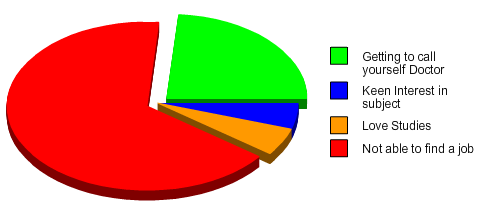
That I should thus be toying with this idea so soon after this harrowing experience may be a pointer to a deeper seated academic masochism that I never knew I was afflicted with prior to this time!
Anyway like I said I am just toying with the idea. The lure of instant immediate 'lucre' may yet prove to be a greater motivation! Spending another two to three years in a pursuit of what some people has mischievously described as a 'Permanent Head Damage', may not really be worth the squeeze.

Yet the thought of a PhD remains alluring.
So if I were to do a PhD what would be my research interest? What area of the law is bound to hold my attention for a minimum of two years without me getting bored?
Without a doubt it will be Maritime and Aviation and all the entangled webs that come with it!
This brings me to the issue I promised to discuss in the last blog post. Emissions Control in the context of Shipping and Aviation.
We will start with International Shipping.
To wet our appetite, let's watch the trio of Mark Major, Policy Officer, International Carbon Market, European Commission; Alfonis Guinier , Secretary General European Community Shipowner's Association; and Per Kageson Professor in Environmental Systems Analysis, Center for Transport Studies talk about how to reduce emissions from International Shipping.
Now that we have put things in context, allow me to don borrowed 'professorial robes' and adumbrate my basic musings on this issue (Hope I am sounding professorial enough?)
Emissions’ control is an emergent issue that is set to shape the future of the Shipping industry. Of particular interest to me is the nexus between Emissions Control and Economic Interests in the context of International Trade. Some of the key considerations would be the effect of existing and emergent International Ship Emissions Regulations on Shipping Finance, International Trade and the desirability or otherwise of Global Regulatory Uniformity in Emissions control.
A pertinent question in the drafting of environmental legislation has always been that of sustainability. Sustainability issues permeate every facet of our existence including regulation. In the light of the recent global economic woes however it is no longer enough for Regulations to be environmentally sustainable. Regulations must endeavour to strike the right balance between sustainability and legitimate economic interests.
In the policy realm there have been a recent slew of measures for reduction of shipping emissions. Such measures take the form of cap-and-trade programs; emissions taxation; emissions standards; low-emissions strategy including R & D efforts into more efficient technologies etc.
But how far has shipping emission regulations sought congruence with Shipping Finance, Global Logistics and Trade? How about the trade implications of such measures? The Shipping industry is an integral part of global trade via its crucial role in International Trade and the global supply chain logistics. It is thus conceivable that any policy that is not in sync with the fundamental parameters that drive the industry is bound to have multiplier effects on the global economy.
There is a current impasse on the underlying international policy to be adopted to craft a global regulation for shipping emission reduction in view of the two conflicting viewpoints- The “Common But Differentiated Responsibility” (CBDR) principle under the UNFCCC which has the support of mainly developing countries and the IMO’s position as canvassed by the International Maritime Organization Secretary General, Mr Efthimios E. Mitropoulos of equality of treatment devoid of blame apportionment.
Although there has been recent progress post Cancun that a fair global deal harmonizing this opposing views could emerge, there is still a considerable risk of having a multiple regulatory regime in the form of regional interventions like the extension of the EU Emissions Trading System to Shipping.
Recital 3 of Directive 2009/29/EC (which implements Phase III of the EU’s Emissions Trading Scheme) provides that:
“In the event that no international agreement which includes international maritime emissions in its reduction targets through the International Maritime Organisation has been approved by the Member States or no such agreement through the UNFCCC has been approved by the Community by 31 December 2011, the Commission should make a proposal to include international maritime emissions according to harmonised modalities in the Community reduction commitment, with the aim of the proposed act entering into force by 2013.”
Giving the myriad of issues including climate change mitigation; the absence of an Emissions assignment mechanism regarding transnational voyage to an individual country due to flexibility in flag state rules; the funding of the Global Climate Fund and needs based apportionment of funds to affected developing countries, trade issues may have not been given adequate consideration.
In an age of economic uncertainty characterized by a global decline in shipping volumes, regulations ought to take into cognisance trade interests even as it seeks to attain a noble environmental aim.
Global Emissions Regulations and Regional measures like the Emissions Trading Scheme (ETS) of the EU implicate some Trade Agreements under the WTO system like the GATT Articles I and III: 4 essentially dealing with the prohibition of horizontal discrimination and the outlawing of measures that may afford protection to like domestic products and the Agreement on Technical Barriers to Trade under the WTO as a possible breach of MFN principle.
ETS being a technical measure may entail mandatory compliance when it is eventually extended to shipping. As a measure to mitigate and adapt to climate change it impacts on trade as it is likely to modify conditions of competition.
ETS derives from commitments to Multilateral Environmental Agreement’s (MEA’s) like the Kyoto Protocol (KP). The rules of the WTO and the MEA’s converge at some point. Article 3.5 UNFCCC and Article 2.3 KP stipulates that measures taken to combat climate change should not constitute a means of arbitrary or unjustifiable discrimination or a disguised restriction on international trade; should be implemented so as to minimize adverse effects on international trade amongst others.
Measures made pursuant to regional schemes like the ETS or even a global agreement has implications for international trade and the shipping industry in terms of a depreciated bottom line due to market access and shipping compliance costs respectively.
Does this hold true for Aviation as well?
This considerations apply mutatis mutandi to Aviation Emissions as well. The hermeneutic considerations have the same jurisprudential' underpinnings. The only differences being that the EU's ETS scheme would apply to airlines flying into the EU from January 1st, 2012 and the ICAO is the body that has the UNFCCC mandate to come up with suitable multilateral regulations for Aviation Emissions Control.
Thus an interdisciplinary research that therefore tries to provide a rational platform for regulations and legislation by expounding the nature of the relationship between emissions control and Shipping or Aviation Finance and International Trade would no doubt provide crucial clarification for future legislations if not out rightly strike the legal balancing chord between sustainability and international trade interests.
The methodology I would adopt if I were to do a PhD in this area would be to examine all the possible trade law implications existing and emergent measures may entail, as well as its impact on shipping finance and international trade through empirical studies and extensive review of the various actions on shipping Emissions with a view to determining not only the linkages but the areas of conflict and to finally distill a possible workable compromise where regulations would not create or result in avoidable distortions to trade.
So that is it! But would I really go ahead down this route or not? Would I seriously consider doing a PhD Doesn't time always tell?
I'll leave you with a poignant discussion of some of the broader issues regarding sustainability, green technologies etc.
Ke mesia (Ibo for see you later!)


No comments:
Post a Comment