
I remember my Fine Arts class in First Grade and then onwards until I gave up notions of becoming another Rembrandt later in Junior High. I remember learning to sketch objects using crayons and watercolour. My favourite things to sketch then where- boys, girls and cars. In that order. I could do the first two reasonably competently. That is if you define competence as drawing an O and then string of _____ / \ - angled awkwardly to form the torso, hands and legs with a smattering of ////\\\\\ on the O (the head) to differentiate between the boys and the girls.

At the third task I was a hilarious disaster for a long time. You can’t blame me though. The third is decidedly more complicated. It didn’t prevent my teachers from asking me to draw it and me from making a huge mess of it.
But I have come to realize that drawing among other benefits is particularly useful to stimulate observation skills. Before you scoff at that, let me ask a question. How observant are you? Hang on a sec. How observant are people generally? Hold on to your partisan answer.
But I have come to realize that drawing among other benefits is particularly useful to stimulate observation skills. Before you scoff at that, let me ask a question. How observant are you? Hang on a sec. How observant are people generally? Hold on to your partisan answer.
A little experiment should settle this. Watch

How observant are people?
Hilarious innit? It would seem people are not very observant. In fact people are generally hopelessly unobservant. Yet observation is such a fundamental trait. The secret of art lies in observation. So also does learning. For to learn is to observe. To discern. I would go as far as saying that success and failure in marriage, in work, in life is oft determined by the ability to observe. Without being overtly dramatic it could be the difference between life and death.
I have seen ships up close. Been on a few ferries and yacht, but I realized to my embarrassment that while I can wax eloquent on many Maritime Law & Admiralty topics including Charter parties, Carriage of Goods by Sea etc., I would most definitely fumble if you ask me to draw a ship. Even worse if you ask me to identify accurately the major parts of a ship. That’s saying much for one who professes to be a Transportation & Logistics practitioner. But before you stand there and sneer at me, can you please draw and label a modern ship and while you are at it an airplane as well?
I have seen ships up close. Been on a few ferries and yacht, but I realized to my embarrassment that while I can wax eloquent on many Maritime Law & Admiralty topics including Charter parties, Carriage of Goods by Sea etc., I would most definitely fumble if you ask me to draw a ship. Even worse if you ask me to identify accurately the major parts of a ship. That’s saying much for one who professes to be a Transportation & Logistics practitioner. But before you stand there and sneer at me, can you please draw and label a modern ship and while you are at it an airplane as well?
If you have ever seen a modern ship or an airplane and what you sketched doesn’t look like this…

or like this…

I suggest you go back to Junior High!
Now let’s identify the major parts shall we? First the ship.
1: Smokestack or Funnel or Chimney is a structure for venting hot flue gases or smoke from a boiler or the ship to the outside atmosphere.
2: Stern is the rear part of a ship.
5: Anchor is the heavy object attached to a vessel by a cable or rope and cast overboard to keep the vessel in place.
6: Bulbous bow; is the protruding bulb at the bow (or front) below the waterline. (a feature of many modern ship hulls).
7: Bow is the forward part of a ship.
8: Deck is a floor or level of a ship. The section of the deck in the picture is also known as the forecastle.
9: Superstructure is an upward extension of an existing structure above a baseline. It is those parts of the ship that project above her main deck.
Then the plane…

- The fuselage, is a long, thin body, often cylindrical, and usually with tapered or rounded ends to make its shape aerodynamically smooth. The fuselage may contain the flight crew, passengers, cargo or payload, fuel and engines the aircraft is designed for or they may be attached to it.
- The cockpit is located at the front or top of the fuselage and equipped with controls and usually windows and instruments is where the pilots of manned aircraft operates it from.
- The wing deflects air downward as the plane moves forward, generating lifting force to support it in flight. The wing also stabilises the plane's roll (tilt left or right), and the wing-mounted ailerons control rotation about the roll axis. A wide variety of wing configurations (e.g., multiplane aircraft and delta wing planform) have been used.
- A vertical stabiliser is a vertical surface mounted at the rear of the plane and typically protruding above it. The vertical stabilizer stabilises the plane's yaw (turn left or right) and mounts the rudder which controls its rotation along that axis.
- A horizontal stabiliser or elevator, or tailplane, is mounted at the tail of the plane, near the vertical stabilizer. The horizontal stabilizer is used to stabilise the plane's pitch (tilt up or down) and mounts the elevators which provide pitch control. A fixed portion of the elevators may be omitted in which case it is termed an all flying tail. Some planes use a front-mounted canard instead of a rear-mounted horizontal stabilizer.
- The engines provide thrust to push the plane forward through the air. The most common propulsion units are propellers (powered by reciprocating or turbine engines) and jet engines (which provide thrust directly from the engine and usually also from a large fan mounted within the engine).
- The Landing gear is a set of wheels, skids, or floats that support the plane while it is on the surface. On seaplanes the bottom of the fuselage or floats (pontoons) support it while on the water. On some planes the landing gear retract during flight to reduce drag.
- The Rudder, (yes a plane like a ship has a rudder) are pedals, which control rotation of the plane about the yaw axis. There are two pedals that pivot so that when one is pressed forward the other moves backward, and vice versa. The pilot presses on the right rudder pedal to make the plane yaw to the right, and on the left pedal to make it yaw to the left
So there we go! Catching up on lost drawing time. The parts we labelled are by no means exhaustive. The ship and airplane do have some other parts. The whole idea is to elevate our transportation vocabulary beyond Carburettor and Radiator. I’m pretty much certain too that our observation skills have stepped up a notch. At least mine has!
Hopefully next time we won’t flinch when asked to draw an airplane or a ship.
Now draw this old steam train:
 Hahahaha. Wipe away your tears.
Here you go. All done without breaking a sweat.
How about the parts of a train? For the avoidance of doubt, much like the Age of Sail in shipping that alludes to an age when sails were the predominant design preference for a ship, the Age of Steam featured steam powered locomotives.
The steam trains like the one above have given way to sleeker electric & diesel powered variants. But for the heck of it I’m gonna have to ask you to identify the parts labelled 1-47 in the picture below.
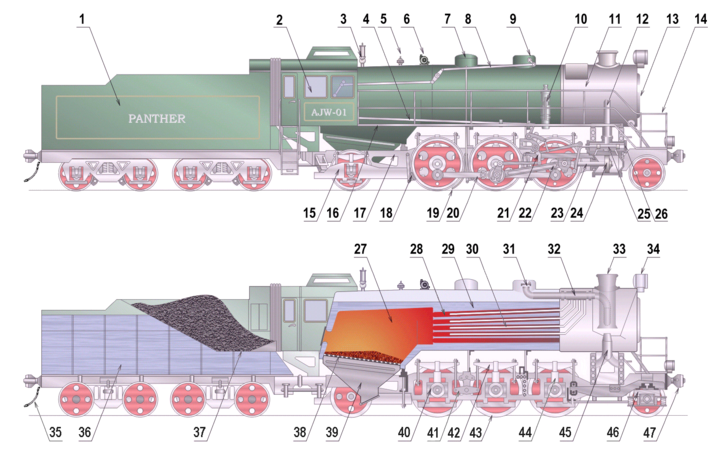
Don’t tell me you are totally nonplussed again?
Sigh.
Anyway I’m in a good mood today. Put yourself out of your misery. Go here.
Sigh.
Anyway I’m in a good mood today. Put yourself out of your misery. Go here.
At this point you probably would have come to the realization (like I did long ago) that you would never be a Rembrandt. For your efforts thus far though I have a gift for you-an eye candy…

It’s Rembrandt’s famous Christ in the Storm on the Lake of Galilee portrait.
Sheer genius!
You may never be a Rembrandt but you would always be uniquely YOU!
Stay Sprightly!
You may never be a Rembrandt but you would always be uniquely YOU!
Stay Sprightly!


No comments:
Post a Comment